



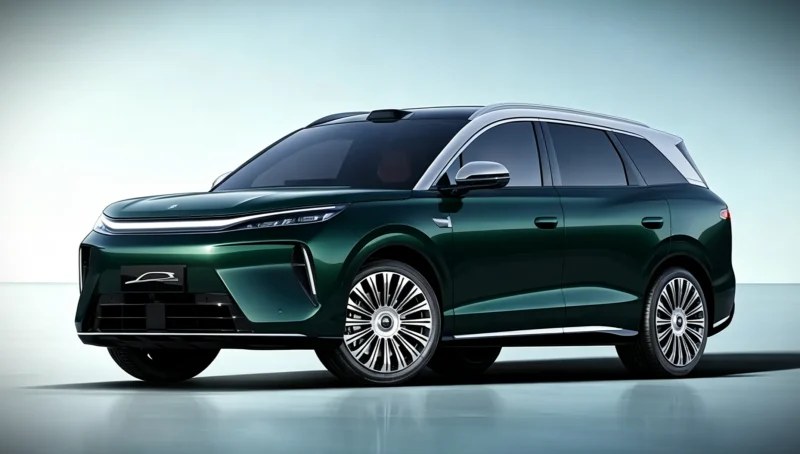

BYD has revealed the production design of the new 8 Series Tang electric SUV, adding another large pure-electric model to the Dynasty lineup while leaving the future relationship between its growing Tang family unclear.
Released by Lu Tian, General Manager of BYD Dynasty Series, the finalised design images arrived shortly after the SUV appeared in China’s Ministry of Industry and Information Technology (MIIT) catalogue. The filing provided the first confirmed details on the model’s dimensions, seating options, and electric powertrain.
The bigger question is where the new SUV fits. The 8 Series Tang joins the Tang L and the larger 9 Series Da Tang in BYD’s domestic SUV family, while overseas markets have used the Atto 8 and Sealion 8 names for related models. Whether the new SUV eventually replaces the Tang L or remains positioned separately has not yet been clarified by BYD.
Another Tang enters the lineup
Listed in MIIT records under the codes BYD6500BBBEV1 and BYD6500BBBEV2, the new SUV is officially positioned as a mid-to-large model focused on a “large five-seat” family layout. The regulatory data, however, shows that BYD has also prepared additional seating flexibility.
One registered variant is listed as a five-seat model, while the other supports both five-seat and seven-seat configurations. The SUV measures 5,045 mm in length, 1,980 mm in width, and up to 1,760 mm in height, with a 2,950 mm wheelbase and 1,700 mm front and rear tracks.
Both versions use lithium iron phosphate (LFP) batteries and BYD’s TZ205QYD permanent-magnet synchronous motor. The motor produces 300 kW of peak power and 150 kW of rated output, with the MIIT filing listing a top speed of 250 km/h. Battery capacity and pack specifications have not yet been disclosed.

The 800 km question
The headline figure surrounding the 8 Series Tang is BYD’s claim that the SUV will deliver more than 800 km of pure-electric range.
For now, that number remains an official manufacturer claim. BYD has not released the battery capacity, detailed testing conditions, or independent verification data needed to show how the target was achieved.
Media reports have linked the model with second-generation Blade Battery technology, flash charging capability, and DiSus-A intelligent body control with dual-chamber air suspension. Those features, however, have not been confirmed through BYD’s announcement or the available MIIT documents.
BYD’s Tang family gets more complicated
The arrival of the 8 Series Tang adds another layer to BYD’s expanding large SUV lineup. China EV DataTracker data shows Tang L domestic sales reached 629 units in June 2026, compared with 3,338 units in December 2025, although the figures alone do not establish that the new model is intended as a direct replacement.
For now, the final positioning between the 8 Series Tang, Tang L, and 9 Series Da Tang remains open. Pricing, battery details, and official launch information will determine how the three models are separated within BYD’s SUV strategy.
We expect the 8 Series Tang to arrive in the second half of 2026, but BYD has yet to announce an official launch schedule. More details are expected as the model approaches its market debut.
Updated: 18/07/2026 13:00 China time
Create an account or sign in to leave a review
There are no reviews to display.