




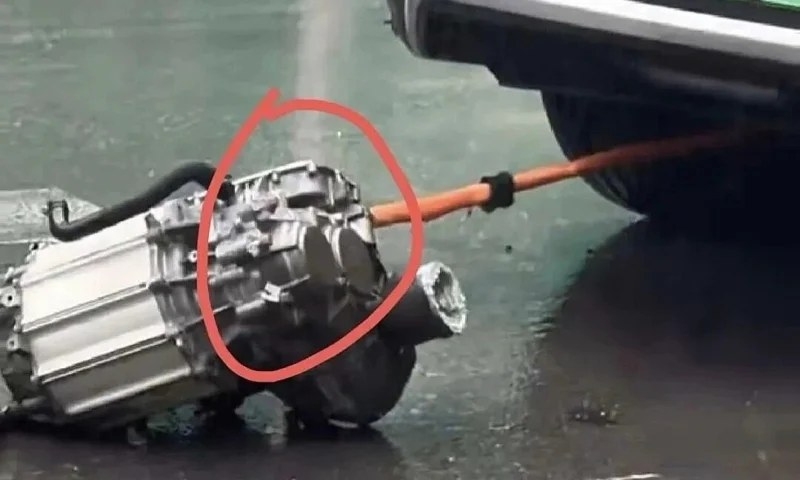

BYD says the rear motor assembly seen dragging behind a Tang SUV in Shenyang detached after the vehicle struck a submerged object while driving through floodwater, describing the incident as impact damage rather than a manufacturing defect.
The explanation came during a July 14 telephone inquiry by Langzhang News (浪涨新闻) with BYD Auto’s official customer service.
The company explained that the Tang “experienced a severe underbody collision” and that the damage was “caused by a collision while wading through water, not a quality issue.”
The response comes a day after we first reported the incident, when videos from flooded streets in Shenyang showed a Tang dragging a large metallic assembly beneath its rear bumper, sparking online jokes that the SUV had “given birth” to its rear motor.

Underbody impact identified as the cause
According to BYD’s customer service, operating data and damage to the mounting points indicate the rear electric drive motor assembly was torn loose after the SUV struck a submerged object while driving through floodwater.
The footage clearly showed the detached motor assembly trailing behind the SUV, but BYD did not immediately explain what had happened. That fueled widespread speculation online.
The footage shows the motor assembly hanging beneath the SUV after breaking away from its mounting points. The Tang continued moving with its lights still operating, while the assembly remained tethered underneath the vehicle.


Mirrors executive warning issued five days earlier
BYD’s explanation closely echoes a warning issued by Executive Vice President He Zhiqi on July 8, just five days before the Shenyang incident.
He said Blade Battery packs meet IP67 and IP68 ingress-protection standards for emergency situations, but stressed that those ratings should never be interpreted as permission to drive through deep floodwater. Instead, he warned that submerged rocks, curbs and other unseen obstacles could severely damage a vehicle’s underbody even if the battery and high-voltage system remain protected.
We previously reported on those flood-safety warnings after self-organised relief convoys entered flood-hit regions in southern China.
BYD has not published a written technical report or inspection findings. For now, the July 14 Langzhang News interview is the company’s only public explanation of the incident.
About the BYD Tang
The Tang is BYD’s three-row SUV, offered in both plug-in hybrid and battery-electric versions. Standard DM-i plug-in hybrid versions use a FWD powertrain, while the higher-performance DM-p and dual-motor EV variants feature an AWD layout with a dedicated rear electric drive unit, the same type of assembly involved in the Shenyang incident.
Depending on the variant, the SUV measures up to 4,905 mm long, 1,950 mm wide and 1,725 mm tall, with a 2,820 mm wheelbase. Higher trims are equipped with BYD’s DiPilot 300 driver assistance system, powered by an Nvidia Drive Orin X processor and 12 GB of system memory, supporting functions including highway navigation assistance.
Create an account or sign in to leave a review
There are no reviews to display.