



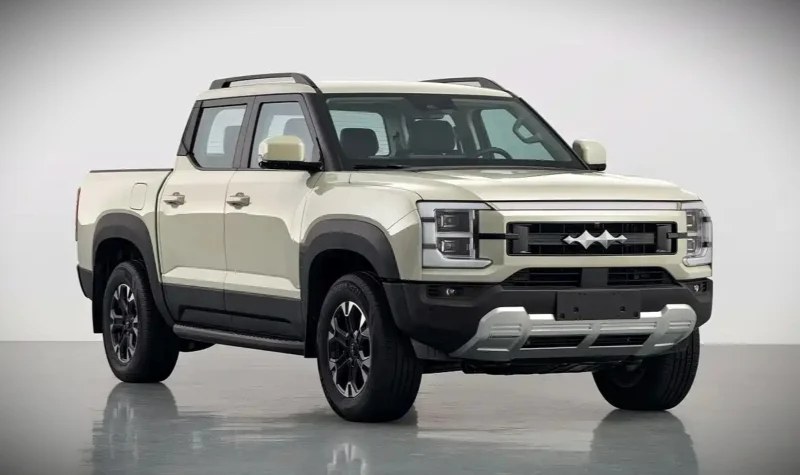

The BYD Shark 6 plug-in hybrid pickup truck has completed its regulatory registration for the Chinese market, where it will be sold under the Fang Cheng Bao brand as the Fang Cheng Bao Shark. The upcoming vehicle appeared in the latest public catalogue from the Ministry of Industry and Information Technology (MIIT). This filing marks the official move to bring the truck to its home market following its initial launch overseas.
The crew-cab truck is built on the specialised DMO platform shared with the brand’s rugged SUV lineup. It measures 5,457 mm long, 1,971 mm wide, and 1,925 mm tall, riding on a 3,260 mm wheelbase. The integrated cargo bed is 1,520 mm long, 1,530 mm wide, and 515 mm deep.
Powertrain and battery
The domestic version features a 1.5T turbocharged gasoline engine paired with a dual-electric-motor setup. The internal combustion engine produces a gross output of 143 kW with a certified net power rating of 135 kW. This hybrid powertrain allows a top speed of 180 km/h, a noticeable bump over the 160 km/h of the overseas model.
To optimise off-road capabilities, the truck relies on independent front and rear electric drive units. The front motor delivers a peak power of 170 kW with a continuous rated output of 80 kW, while the rear electric motor generates a peak power of 150 kW and a rated output of 70 kW.
Compared to global variations, the domestic model features a slightly different powertrain tune. While the standard global 1.5T model delivers a combined system peak of 321 kW (430 hp), and the top-tier international variant reaches 350 kW (469 hp), the Chinese version pairs its 143 kW engine with a combined electric motor peak of 320 kW. This layout keeps the same 170 kW front and 150 kW rear motor sizes as the global truck, but adjusts the tuning to unlock the higher 180 km/h top speed limit.
Hardware and options
The truck has a curb weight of 2,710 kg and a gross vehicle weight rating of 3,495 kg. It offers a payload capacity of 460 kg and a maximum towing capacity of 2,500 kg. The approach and departure angles are certified at 31 degrees and 22 degrees, respectively, though opting for a tow hitch drops the rear departure angle to 20 degrees.
The regulatory data shows the truck uses a lithium iron phosphate (LFP) battery supplied by BYD’s FinDreams subsidiary. Braking safety is handled by a Bosch ABS system. Buyers can customise the look with different front grille designs and an optional rear cursive nameplate.
Strategy and market
The domestic launch comes at a critical time, as BYD Shark 6 exports dropped 25% year-on-year in the first half of 2026. Bringing it home allows BYD to tap into growing local demand for new-energy pickups in mainland China. Industry analysts note that advanced Chinese plug-in trucks are shifting the segment’s landscape, echoing earlier comments from Ford CEO Jim Farley regarding how competitive Chinese pickups have become.
June 2026 retail data from China EV DataTracker shows that Fang Cheng Bao delivered 27,907 vehicles, marking a 5.9% month-on-month increase and 47.6% growth year-on-year. This volume secured a 1.7% market share for the brand in China during the month.


Updated: 13/07/2026 16:20 China time
Create an account or sign in to leave a review
There are no reviews to display.