



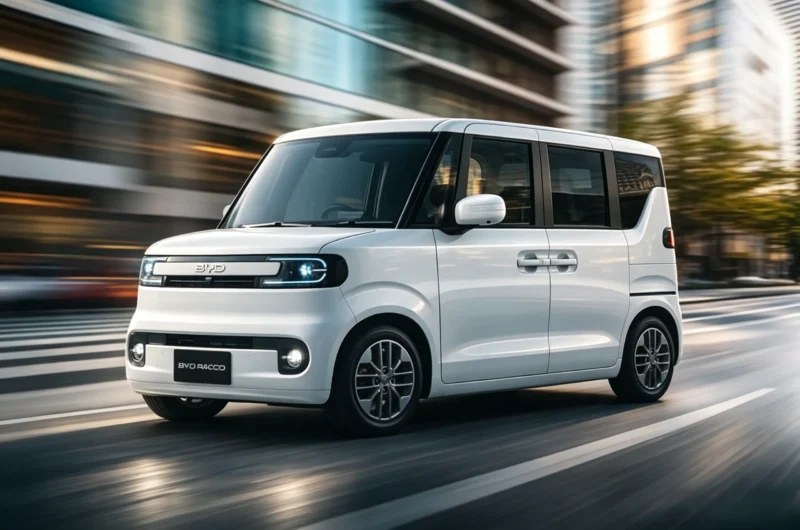

BYD will officially launch the right-hand-drive Racco electric microcar to the Japanese consumer marketplace on July 28, 2026, according to EV-Times. This newly developed model marks a competitive entry into the protected domestic K-car segment to capture urban market share. TV commercials starring actress Alice Hirose have already started airing under the “Racco Raku” slogan to build anticipation before the launch.
The microcar measures 3,395 mm in length, 1,475 mm in width, and 1,800 mm in height, with a wheelbase of 2,520 mm. This specialised architecture optimises interior space for suburban commuters, building on the launch of the Sealion 6 crossover.
Trims and performance
The series offers two battery options to serve different driving needs. The 200 variant combines a 22.4 kWh battery with an official 210 km operational range under local WLTC testing cycles. Upgrading to the 300 tier provides a larger 35.84 kWh configuration, extending driving range to 320 km.
This gives the final version more range than early prototypes indicated. The entry version carries an adjusted base price of 120,000 yuan (17,700 USD) following regulatory interventions. Charging uses a fast-charging infrastructure peaking at 50 kW across public networks.

Market pricing dynamics
While the 50 kW charging rate matches the Honda N-One e’s, it exceeds the Nissan Sakura’s 30 kW charging capacity. However, pressure from local automakers forced a change in the pricing strategy. While lower manufacturing costs originally allowed for a cheaper target price, the microcar is launching at this higher adjusted base.
Local incumbents like Suzuki historically identified the incoming platform as a major competitive threat to their segment dominance. To navigate these barriers, the group appointed a former Nissan specialist to guide regional corporate strategy. The premium tiers justify this adjusted cost structure by introducing segment-first electric sliding doors with hands-free foot sensors.
Utility and scaling
The modular rear seating row folds completely flat, unlocking up to 1,372 litres of cargo space for deliveries. The cabin also features digital NFC keys, automated battery preheating for winter driving, and heated cup holders.
This international expansion project is fully financed by sustained production volume within the automaker’s home assembly network. June 2026 records confirm the Yuan UP led domestic compact output with 17,945 units, scoring a 5.3% sequential expansion. The Song Pro DM-i added 17,439 deliveries, while the Sealion 06 and Qin Plus EV secured 16,843 and 13,726 sales, respectively. According to China EV DataTracker.

Create an account or sign in to leave a review
There are no reviews to display.