




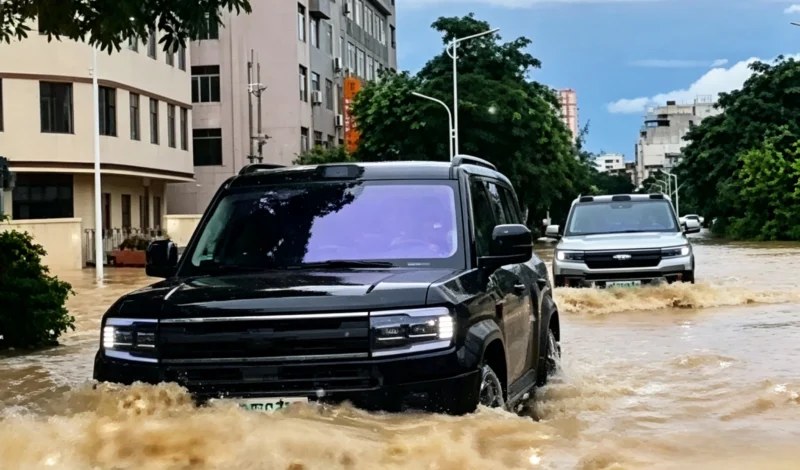

BYD convoys consisting of Denza and Fang Cheng Bao vehicles have entered deep flood zones in the Guangxi region to deliver emergency civilian relief supplies, according to 163. The volunteer operations materialised spontaneously through local owner networks following historic regional rainfall from Typhoon Mesaak. These volunteer fleets headed straight into the worst of the floodwaters, defying standard guidelines for driving in severe weather.
Engineering blueprints for these new energy vehicles emphasise high-voltage battery insulation and robust factory wading clearances. The non-bearing chassis architecture of the Fang Cheng Bao brand provides a certified wading depth of 800 mm, along with specialised underbody structural sealing. These physical parameters allow the vehicles to maintain traction across waterlogged provincial routes that routinely disable conventional internal combustion engines.
Executive safety directives
BYD Senior Vice President He Zhiqi published a directive on social media clarifying that new energy vehicles are not amphibious boats. The executive noted that while the proprietary Blade Battery components achieve certified IP67 and IP68 ingress protection standards, driving through deep water remains an operational risk. The factory specification guarantees submerge protection up to 1 meter for 24 hours without triggering thermal runaway or electrical leakage.
Despite these explicit corporate cautions, the civilian BYD convoys travelled through deep waterlogged municipal sectors to reach isolated villages. Enthusiasts utilised the continuous power delivery of localised battery packs to maintain momentum through moving silt and debris. This grassroots mobilisation highlights a distinct separation between conservative factory operating guidelines and real-world consumer hardware application during sudden environmental challenges.
Flagship field evaluation
The citizen rescue operations featured premium BYD vehicle models. Onlookers documented the Denza N9 luxury plug-in hybrid flagship navigating heavy mud pools during the relief mission. These high-end configurations utilise multi-motor intelligent four-wheel-drive platforms to safely navigate low-traction environments.
The deployed fleet also utilised vehicles equipped with the latest structural chassis updates. Observers noted the presence of the Fang Cheng Bao Bao 8 hardcore off-road sports utility vehicle, featuring advanced suspension technology that assists with cargo distribution. These units include the Denza B5 and Denza B8, which feature active body control systems that dynamically adjust clearance heights to bypass obstacles.
Corporate capital relief
Automakers have simultaneously allocated significant financial capital to support regional reconstruction efforts. The BYD Charity Foundation announced a direct donation of 10,000,000 yuan (1,469,900 USD) to fund frontline emergency teams and public infrastructure repair. Competitors also mobilised financial resources, with consumer technology giant Xiaomi allocating 10,000,000 yuan (1,469,900 USD) in cash, while Chery Auto Group committed a combined total of 10,000,000 yuan (1,469,900 USD) split between financial aid and physical supplies.


Updated 09/07/20206 22:00 China time
Create an account or sign in to leave a review
There are no reviews to display.