




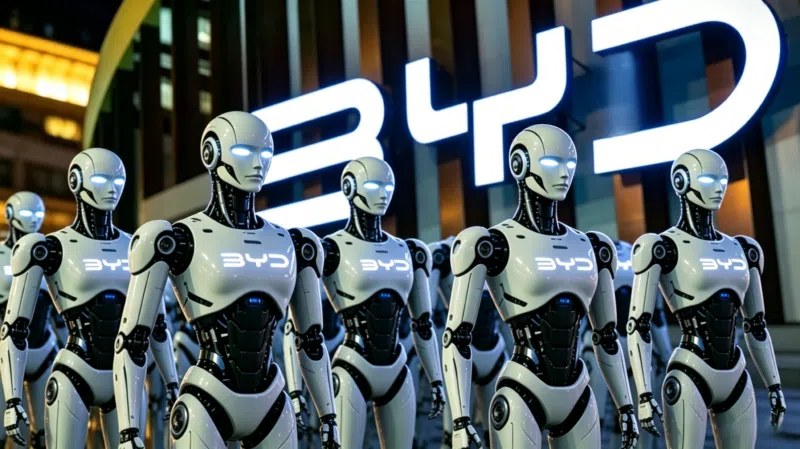

Chinese EV giant BYD has officially confirmed that it is developing humanoid robots, marking the company’s most direct public statement yet on its ambitions beyond automobiles, according to First Financial.
BYD Executive Vice President Li Ke said the company is already working on humanoid robots and believes the key competitive factors in the sector will be manufacturing, software, and hardware capabilities.
She added that automotive AI and robotics share common technological foundations. If humanoid robots eventually become household products, BYD could distribute them through its existing dealer network.
BYD sees overlap between cars and robots
Li Ke said the company’s automotive AI expertise can be applied to robotics because both industries rely on perception, decision-making, motion control, software integration, and hardware engineering.
Humanoid robots combine many technologies already used in modern intelligent vehicles, including sensors, electric actuators, batteries, computing platforms, and AI models. Vehicle manufacturers also possess large-scale manufacturing experience, supply-chain management capabilities, and expertise in safety-critical systems.
These similarities have encouraged several Chinese automakers to explore robotics as a potential extension of their existing technology stacks.
Open-platform approach discussed
Li Ke said BYD could create an open platform rather than limiting itself to internally developed products.
Under that approach, the company could manufacture its own robots while also cooperating with external robotics companies. Such a model would resemble BYD’s broader strategy in the automotive sector, where the company develops core technologies internally while maintaining extensive supplier and partner networks.
The executive did not provide a commercialisation timeline, technical specifications, investment figures, or production targets.
Chinese automakers accelerate humanoid robot efforts
BYD joins a growing list of Chinese automakers entering the humanoid robotics sector.
In April, we reported that Chery began online sales of a humanoid robot equipped with a 0.7-kWh battery and priced at 280,000 yuan (41,400 USD). The move made Chery one of the first major Chinese automakers to publicly commercialise a humanoid robot product.
Another industry participant is Xpeng, which has increasingly linked its AI development strategy with future robotics applications. The company has positioned artificial intelligence, autonomous driving, and embodied AI as related technology domains. Earlier, Xpeng unveiled navigation-free driving capabilities and L4 robotaxi plans, highlighting the growing convergence between automotive AI and robotics.
Sales Context
BYD remains China’s largest new-energy vehicle manufacturer by volume. The company sold 321,123 vehicles in April 2026. Its best-selling model that month was the Sealion 06, which recorded 19,649 deliveries, followed by the Yuan UP at 15,658 units and the Dolphin at 14,218 units, according to China EV DataTracker.

Create an account or sign in to leave a review
There are no reviews to display.