




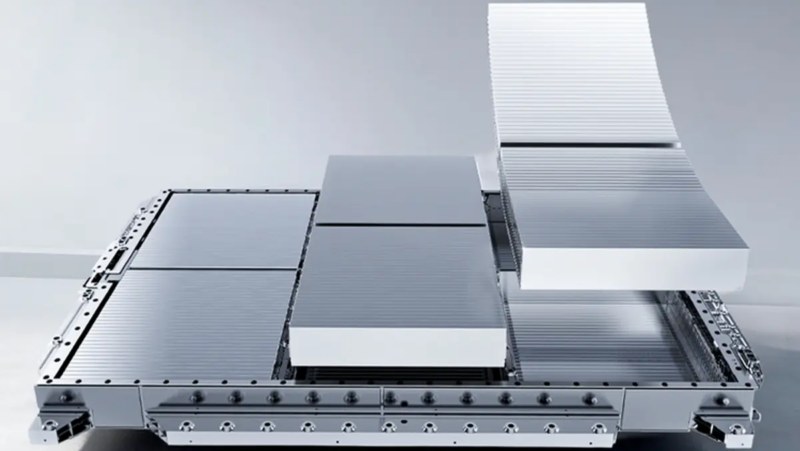

As the new energy vehicle (NEV) market penetration surpasses 60%, the battle for dominance has shifted toward battery performance. At the centre of this shift is BYD’s second-generation Blade Battery and its “Flash Charge” technology. In a recent in-depth interview with 36kr Auto, Sun Huajun, CTO of BYD’s battery division, addressed industry scepticism and outlined the company’s vision for the future of Lithium Iron Phosphate (LFP) technology.
Breaking the 9-minute barrier
BYD’s second-generation Blade Battery introduces staggering performance metrics. Utilising a massive 1500kW charging pile, the battery can charge from 10% to 97% in nine minutes. Even in extreme cold conditions of -30°C, the charge from 20% to 97% takes only three minutes longer than at room temperature.
To support this technology, BYD has launched the “Flash Charge China” strategy, aiming to establish 20,000 flash-charging stations across the country by the end of this year. As of May 6, the company has already completed 5,924 stations.

Addressing heat and safety concerns
The rapid charging speed has sparked debate among industry experts, with some arguing that such high power inevitably generates excessive heat, potentially exceeding the 65°C to 70°C safety threshold for battery materials. Critics worry that high temperatures could damage the SEI film (Solid Electrolyte Interphase), compromising battery life and safety.
Sun Huajun dismissed these concerns as being based on “outdated experience.” He noted that every leap in charging speed – from 1C to 5C- was initially met with claims that it would “hurt the battery.”
“70°C was simply the cognitive boundary of the past,” Sun stated. He explained that the Blade Battery’s symmetrical structure and dual-surface cooling provide a natural advantage for heat management. BYD has optimised the battery dimensions to reduce internal resistance and ensure uniform temperature distribution. According to Sun, the company conducted over 1,000 full flash-charge cycles and simulated extreme long-distance trips – such as driving from Hainan to Harbin – to verify reliability before mass production.
The “high-end” debate
Sun also responded sharply to claims from CATL that using LFP batteries in vehicles priced above 250,000 yuan (36,800 USD) constitutes a “downgrade.” He pointed to the Yangwang U9, a high-performance supercar priced at over 10,000,000 yuan (1,470,600 USD), which utilises LFP technology to achieve elite acceleration and handling.
“Who defines what is ‘high-end’?” Sun questioned. “Is it a battery supplier drawing a line based on energy density, or is it the consumer based on handling, comfort, charging speed, and long-term safety? If a supplier defines high-end, it respects neither the automaker’s engineering nor the user’s judgment.” He reiterated BYD’s philosophy: “Safety is the ultimate luxury.”
Future outlook and strategy
While acknowledging the current energy density of LFP systems – roughly 130 to 140 Wh/kg – Sun expressed confidence that there is still significant room for growth. BYD continues to explore multiple paths, including sodium-ion, solid-state, and “lithium-free” anode technologies, to deepen its understanding of electrochemistry.
Sun believes that flash-charging technology will raise the barrier to entry for the industry. “Anyone can do 1C or 2C charging,” he said. “But doing it in under ten minutes requires deep electrochemical research and systemic engineering that not everyone can achieve in the short term.”
Create an account or sign in to leave a review
There are no reviews to display.