




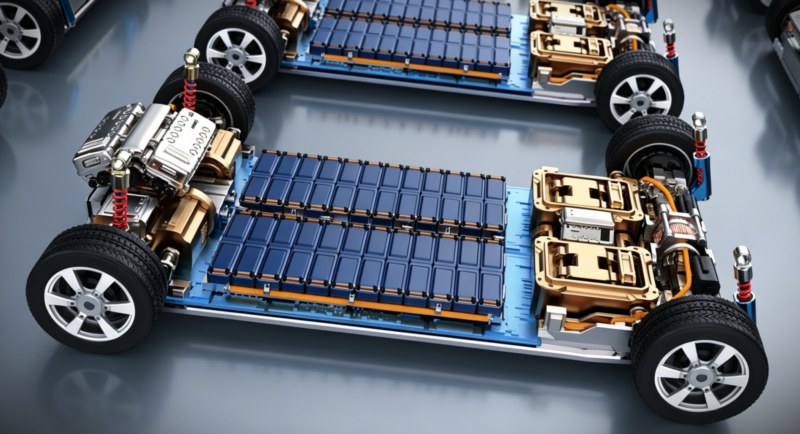

Chinese electric vehicle battery manufacturers are redirecting massive industrial production capacity toward energy storage systems for artificial intelligence data centres. Contemporary Amperex Technology Co. Limited (CATL) leads this expansion alongside regional competitors to capture high-margin infrastructure supply contracts. This transition opens up massive avenues for utility deployment beyond passenger vehicle manufacturing, according to Sina.
China EV DataTracker shows that in China, the average electric vehicle battery capacity reached 70.0 kWh in May 2026, up 37.3% year over year. To leverage this manufacturing scale, market players are securing major grid infrastructure contracts. For instance, a recent data centre storage project contract exceeded 1.5 billion yuan (221.88 million USD).
High-rate cells
Data centre server environments require substantial electrical discharge profiles to manage rapid computational spikes without disrupting the grid. To meet these high-intensity performance thresholds, specialised tier two automotive suppliers are launching specific cell architectures. These advanced components deliver instant power frequencies completely distinct from conventional passenger vehicle specifications.
Competitor product rollouts
REPT BATTERO has introduced an 85 Ah hardware cell capable of delivering a 10C maximum continuous discharge rating. Sunwoda is competing directly by introducing its own 85 Ah cell architecture optimised for an 8C continuous discharge frequency. Concurrently, Eve Energy is deploying specialised cylindrical battery backup units alongside square uninterruptible power supply cell hardware.
Sodium infrastructure race
While CATL Chairman Robin Zeng recently delivered a solid-state battery reality check, stating mass production remains distant, alternative chemistries find immediate utility in stationary platforms. The manufacturer is deploying 300 Ah sodium-ion packs built with a 15,000-cycle lifespan. These packs share physical dimensions with standard lithium housings to achieve platform compatibility.
This heavy industrial rollout explains why BYD is building a sodium battery fortress to dominate next-generation infrastructure. Panasonic is fighting back by allocating 14.9 billion yuan (2.20 billion USD) to build dedicated North American storage assembly lines. However, the Japanese veteran faces significant competitive headwinds from localised scale leaders such as Envision Energy, Hithium, and Sungrow.
Ecosystem integration loops
To lock down supply lines, Chinese battery manufacturers are executing direct equity investments into data centre operators. Companies like Ampace, Shuangdeng Group, Highpower Technology, and Vision Group are similarly rolling out customised power architectures. This coordinated industrial strategy ensures a steady demand loop for high-capacity cell fabrication lines.
Strategic market outlook
Recent project implementations confirm that commercial delivery timelines are expanding rapidly. In late 2025, CATL finalised a 2 GW grid-scale installation in southwest China, while Vision Group completed an automated immersion-cooling pilot project. These operational milestones validate that the utility computing sector represents a highly profitable second growth curve for global battery giants.
Industrial demand timelines
Global data infrastructure electricity consumption will double by 2030 compared to the initial 2025 baseline. This vast utility requirement ensures that high-output infrastructure storage will remain a core revenue driver for Chinese cell manufacturers. Consequently, the battery battleground is moving directly from the vehicle chassis to the computing network.
Create an account or sign in to leave a review
There are no reviews to display.